Table of Contents
- Key Takeaways
- Quick Verdict
- Product Overview & Specifications
- Real-World Performance & Feature Analysis
- Design & Build Quality
- Performance in Real Use: Two Scenarios
- Ease of Use
- Durability & Reliability
- Pros & Cons
- Comparison & Alternatives
- Cheaper Alternative: Used Canon Rebel T6i or Nikon D5600
- Premium Alternative: Canon EOS R50 or Sony a6100
- Buying Guide / Who Should Buy
- Best For Beginners
- A Tough Sell for Enthusiasts
- Not Recommended For
- FAQ
You’re probably looking at the Canon EOS Rebel T7 because you’ve outgrown your smartphone’s camera. The phone is convenient, but you’re tired of blurry indoor shots, disappointing zoom quality, and that feeling that your vacation photos just don’t look “professional.” You want to step up your photography game, but the world of DSLRs can be intimidating. Is the Rebel T7, a camera that’s been around for several years, still a smart buy for a beginner in 2026?
I’ve shot with everything from decade-old DSLRs to the latest mirrorless flagships. Having used the T7 extensively with beginners in mind, I can tell you its value isn’t found on a spec sheet alone. The real question is whether its combination of price, simplicity, and image quality aligns with your specific needs. This review will cut through the marketing to show you what it’s actually like to live with the T7, where it excels, and where you might feel its limitations.
Key Takeaways
- The T7’s greatest strength is its simplicity and accessibility, making the transition from smartphone to DSLR remarkably smooth.
- Image quality in good light is excellent for the price, but low-light performance requires patience and technique.
- The included 18-55mm kit lens is a decent starting point, but the camera’s true potential is unlocked with better lenses.
- Wi-Fi connectivity works but feels dated compared to modern Bluetooth-based systems for quick photo transfers.
- This is an investment in the Canon ecosystem, offering a clear upgrade path through a vast selection of EF and EF-S lenses.
Quick Verdict
Best For: Absolute beginners on a tight budget, hobbyists who shoot primarily in daylight, and families wanting significantly better photos than a smartphone can provide without a steep learning curve.
Not Ideal For: Videographers (lacks 4K and a microphone jack), serious low-light shooters, or anyone who needs fast continuous shooting for sports/action.
Core Strengths: User-friendly interface, crisp 24MP images in good light, comfortable grip, and access to Canon’s extensive lens library.
Core Weaknesses: Basic 9-point autofocus system, dated DIGIC 4+ processor limits high-ISO performance, and video features are bare-bones.
Product Overview & Specifications
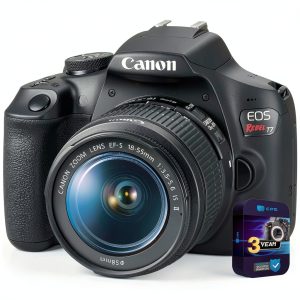
The Canon EOS Rebel T7 (also known as the EOS 2000D) sits at the entry-level tier of Canon’s DSLR lineup. It’s built around a reliable 24.1-megapixel APS-C sensor, a resolution that is more than sufficient for large prints and significant cropping. The core of its appeal is the DSLR experience itself: looking through a bright optical viewfinder to compose your shots. This is a different, more deliberate way of shooting compared to using a smartphone screen.
 Canon EOS Rebel T7 DSLR camera front and back view displaying controls and screen” />
| Specification | Details |
|---|---|
| Sensor | 24.1 MP APS-C CMOS | Processor | DIGIC 4+ |
| ISO Range | 100 – 6400 (Expandable to 12800) |
| Autofocus Points | 9-point AF (center cross-type) |
| Continuous Shooting | 3 fps (frames per second) |
| Video Recording | Full HD 1080p at 30p |
| Display | 3.0-inch, 920k-dot LCD Fixed Screen |
| Connectivity | Wi-Fi, NFC |
| Battery Life | Approx. 500 shots per charge (LP-E10) |
The key takeaway from the specs isn’t any single number, but the overall picture: this is a platform designed for learning. The 9-point autofocus is basic but teaches you to focus and recompose. The 3 fps shooting speed forces you to anticipate the moment rather than spray and pray. It’s a camera that encourages thoughtful photography.
Real-World Performance & Feature Analysis
Design & Build Quality
Picking up the T7, it feels light but not cheap. The plastic body is what you’d expect at this price, but the grip is deep and comfortable, making it easy to hold steady. The button layout is classic Canon—logical and intuitive. After a few hours, you’ll be changing settings without taking your eye from the viewfinder. The fixed LCD screen is a clear cost-saving measure. While fine for reviewing shots, it’s a limitation for video or high/low-angle shooting compared to cameras with articulating screens. For a beginner learning composition, however, the optical viewfinder is the primary tool, and it’s bright and clear.
Performance in Real Use: Two Scenarios
Scenario 1: The Family Day Outdoors. Take the T7 to a park on a sunny day, and it sings. The 24MP sensor captures fantastic detail. Colors are vibrant and true to life—a hallmark of Canon’s color science. The kit lens is sharp enough when stopped down to f/8 or f/11. The Wi-Fi, while a bit clunky to set up initially, is a game-changer here. You can take a great shot of your kids and have it on your phone and Instagram in under a minute. The optical viewfinder eliminates any struggle with screen glare, a significant advantage over smartphones and mirrorless cameras in bright sun.
Scenario 2: Indoor Birthday Party. This is where you feel the T7’s age. The room is dimly lit for ambiance. The camera’s autofocus hunts more, struggling to lock onto moving subjects. To get a sharp shot without a flash, you’ll need to raise the ISO. Beyond ISO 1600, noise becomes noticeable, and fine detail softens. The 3 fps continuous shooting feels slow if you’re trying to capture a series of fast-moving expressions. You’ll need to use the built-in flash or invest in an external speedlite for consistently good results indoors. This isn’t a dealbreaker, but it’s a real-world limitation you must plan for.
Ease of Use
Canon’s Guide Mode is the T7’s secret weapon for beginners. It doesn’t just give you settings; it explains what they do. When you select “Blur the background,” it tells you it’s using a wider aperture and why that works. This is invaluable for moving from Auto to the creative modes (Av, Tv, M). The menu system is clean and well-organized. Compared to more advanced cameras, there are fewer buried custom functions, which actually reduces confusion for a new user.
Durability & Reliability
The T7 is not weather-sealed. A light drizzle might be okay, but it’s not a camera for a rainy hike. That said, the build feels robust enough for everyday use, travel, and the occasional bump. The battery life is excellent, easily lasting a full day of casual shooting. You can go on a day trip without a spare battery, which is a huge plus for beginners who don’t want to manage extra gear.
Pros & Cons
Pros:
- Superb Image Quality in Good Light: The 24MP sensor produces sharp, colorful images that will impress anyone coming from a phone.
- Excellent for Learning: The guided interface and straightforward controls accelerate the learning curve.
- Comfortable Ergonomics: It feels good in the hand, encouraging longer shooting sessions.
- Massive Lens Ecosystem: Access to Canon’s vast and often affordable used lens market.
- Great Battery Life: You can shoot all day without worrying about power.
Cons:
- Struggles in Low Light: High ISO performance is the camera’s biggest technical weakness.
- Basic Autofocus System: The 9-point system feels outdated for moving subjects.
- Limited Video Capabilities: No 4K, and the lack of a microphone jack makes serious video work impossible.
- Dated Connectivity: Wi-Fi-only transfer is slower and less seamless than modern Bluetooth/Wi-Fi hybrids.
- Fixed LCD Screen: Limits creative shooting angles.
Comparison & Alternatives
It’s impossible to evaluate the T7 without looking at its main competitor and other options in the market.
Cheaper Alternative: Used Canon Rebel T6i or Nikon D5600
Instead of a new T7, consider a used or refurbished model one tier up from a previous generation, like a Canon T6i or a Nikon D5600. For a similar price, you’ll often get a more advanced autofocus system (19-point cross-type vs. 9-point), a vari-angle touchscreen, and faster continuous shooting. The image quality will be comparable, but the overall user experience and capability for growing your skills are significantly better. Verdict: If you’re comfortable buying used, this is often a smarter value proposition.
Premium Alternative: Canon EOS R50 or Sony a6100
Stepping up to a modern entry-level mirrorless camera like the Canon EOS R50 or Sony a6100 is a substantial jump in price but also in capability. You’ll get significantly faster and more accurate autofocus (including eye-tracking for both photos and video), 4K video, a more compact body, and a real-time preview of your exposure in the electronic viewfinder. Verdict: If your budget allows, these cameras are more future-proof and offer performance that closes the gap between beginner and enthusiast levels.
Buying Guide / Who Should Buy
Best For Beginners
The T7 is perfect if you are brand new to photography, are on a strict budget, and want a simple, reliable tool to learn the fundamentals. Its limitations (like the basic AF) can actually be beneficial, forcing you to learn technique rather than relying on technology.
A Tough Sell for Enthusiasts
If you already understand aperture, shutter speed, and ISO, you will likely find the T7’s autofocus and performance constraints frustrating quickly. You’d be better served by a used mid-range DSLR or saving for an entry-level mirrorless camera.
Not Recommended For
- Videographers: The lack of 4K and a microphone jack makes it unsuitable for anything beyond casual home movies.
- Action/Sports Photographers: The 3 fps burst rate and 9-point AF system are inadequate for capturing fast-paced action.
- Low-Light Specialists: If you frequently shoot indoors or at night without a flash, the T7’s high-ISO performance will disappoint.
FAQ
Is the Canon T7 good for YouTube?
Not really. While it can record 1080p video, the lack of a microphone input means you’ll be stuck with poor-quality audio from the built-in mic. The autofocus is also slow and noisy during video recording. For serious video creation, look elsewhere.
Can I use my old Canon lenses on the T7?
Yes, that’s a major advantage. The T7 uses the EF/EF-S mount, so it’s compatible with decades of Canon DSLR lenses. This gives you access to a huge and affordable used lens market.
T7 vs. a smartphone camera: which is better?
For controlled lighting and planned shots (portraits, landscapes), the T7’s larger sensor will always produce higher quality images with better background blur. For quick snapshots, video calls, and computational photography tricks (like night mode), a modern flagship smartphone is more convenient. The T7 requires more effort for a better result.
Is the Canon T7 worth it in 2026?
It’s a qualified yes. Its value is highly dependent on price. If you can find it at a significant discount as a kit, it remains a legitimate entry point into interchangeable-lens photography. However, if the price is close to that of a refurbished T7i or a used mirrorless camera, the older T7 is hard to recommend.
What is the first lens I should buy after the kit lens?
The Canon EF 50mm f/1.8 STM (the “nifty fifty”) is the essential first upgrade. It’s inexpensive and lets in much more light, dramatically improving low-light performance and background blur, teaching you about prime lenses in the process.