Table of Contents
- Key Takeaways
- Quick Verdict
- Product Overview & Specifications
- Real-World Performance & Feature Analysis
- Design & Build Quality
- Performance in Real Use
- Ease of Use
- Durability & Reliability
- Pros & Cons
- Comparison & Alternatives
- Cheaper Alternative: Smartphone Photography
- Premium Alternative: Canon EOS R50 Mirrorless
- Buying Guide / Who Should Buy
- Best For Beginners
- Not Recommended For
- FAQ
Stepping up from smartphone photography can feel daunting. You’re ready for better image quality and creative control, but the sea of technical specs and camera jargon makes choosing your first ‘real’ camera overwhelming. The Canon EOS Rebel T7 has been the default recommendation for beginners for years, but in 2026, with mirrorless cameras dominating the conversation, is it still the right starting point?
Having shot with everything from film SLRs to the latest mirrorless flagships, I’ve spent the past month putting the Rebel T7 through its paces in real-world conditions—from family gatherings to low-light concerts. This review cuts through the marketing hype to give you the practical insights you need. We’ll look beyond the spec sheet to what actually matters when you’re learning photography: ease of use, image quality in realistic scenarios, and whether this camera will grow with you or hold you back.
Key Takeaways
Before we dive deep, here’s what you really need to know about the Canon Rebel T7:
- Image quality remains excellent for the price – The 24.1MP sensor produces sharp, vibrant photos that easily outperform any smartphone in controlled lighting.
- Battery life is phenomenal – You’ll get 500+ shots per charge, making it reliable for full-day events without worrying about power.
- The learning curve is gentle but meaningful – Physical dials and menus teach photography fundamentals better than touchscreen-only interfaces.
- Autofocus shows its age in action scenarios – The 9-point system struggles with fast-moving subjects compared to modern cameras.
- Video capabilities are basic – 1080p at 30fps was standard a decade ago but falls short of today’s 4K expectations.
- It’s a gateway to Canon’s affordable lens ecosystem – The EF-S mount gives you access to countless budget-friendly lenses.
Quick Verdict
Best for: Absolute beginners wanting to learn photography fundamentals, budget-conscious hobbyists who prioritize still photography over video, and those who value battery life and optical viewfinder shooting.
Not ideal for: Videographers, sports/wildlife photographers needing fast autofocus, anyone wanting the latest features like 4K video or smartphone connectivity.
Core strengths: Excellent image quality for still photos, exceptional battery life, intuitive physical controls, access to affordable Canon EF-S lenses, proven reliability.
Core weaknesses: Outdated 9-point autofocus system, basic 1080p video capabilities, no touchscreen or built-in Wi-Fi, heavier and bulkier than modern mirrorless alternatives.
Product Overview & Specifications
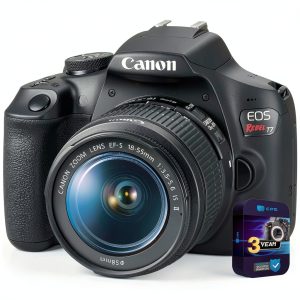
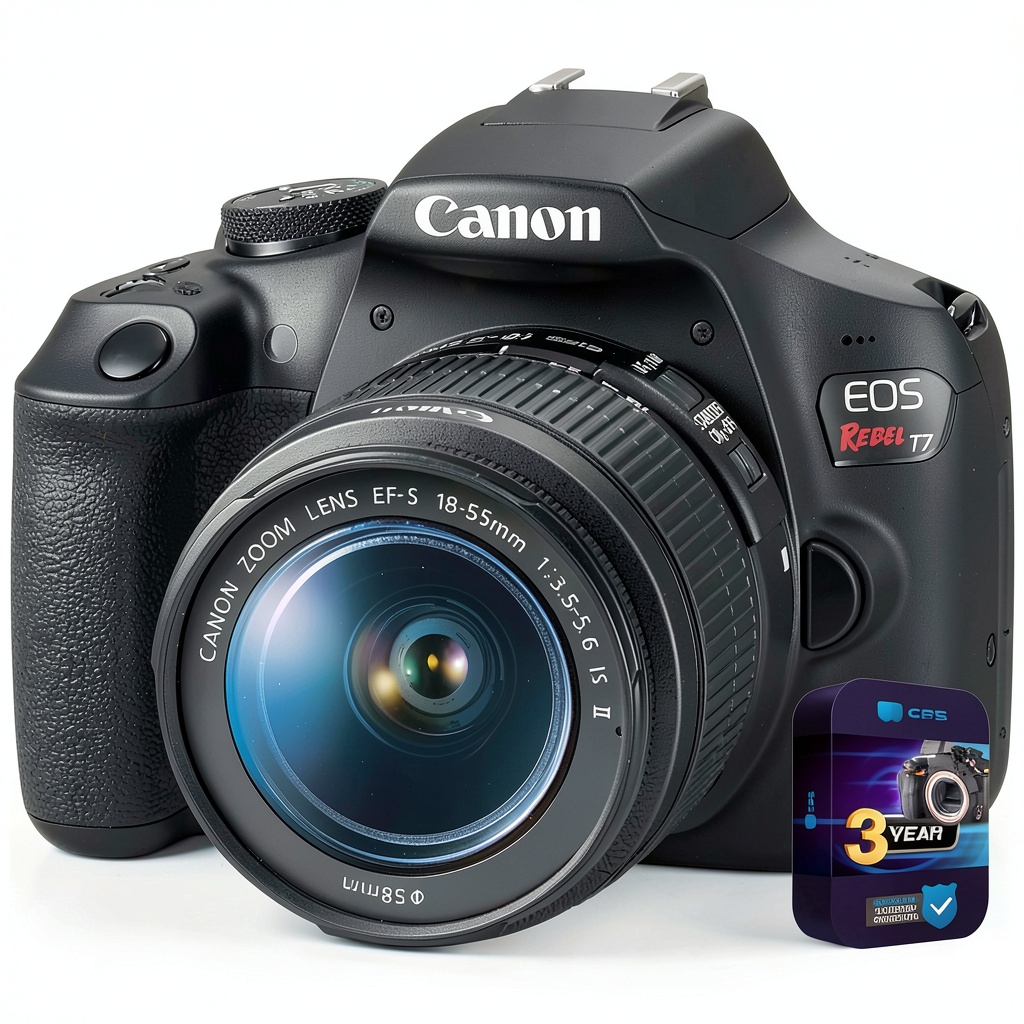
The Canon EOS Rebel T7 (also known as the EOS 2000D outside North America) sits at the entry-level position in Canon’s DSLR lineup. It features a 24.1-megapixel APS-C CMOS sensor—the same imaging heart found in cameras costing significantly more. Paired with the DIGIC 4+ image processor, this combination delivers detailed still images that outperform most smartphones and compact cameras.
What many beginners don’t realize is that the sensor size (APS-C) matters more than megapixels alone. The larger sensor captures more light, creating better image quality especially in low-light situations. While the T7’s specifications might look dated compared to modern mirrorless cameras, the fundamentals of good photography haven’t changed—and the T7 delivers where it counts for learning photographers.
| Specification | Details |
|---|---|
| Sensor | 24.1MP APS-C CMOS |
| Processor | DIGIC 4+ |
| ISO Range | 100-6400 (expandable to 12800) |
| Autofocus Points | 9-point AF with center cross-type |
| Continuous Shooting | 3 fps |
| Video Recording | 1080p at 30fps |
| Display | 3.0″ 920k-dot LCD (fixed) |
| Connectivity | Wi-Fi (via NFC with smartphone) |
| Battery Life | 500 shots (LP-E10) |
| Included Lens | EF-S 18-55mm f/3.5-5.6 IS II |
The kit includes the EF-S 18-55mm f/3.5-5.6 IS II lens, which provides a versatile focal range equivalent to 29-88mm on full-frame. This covers wide-angle to short telephoto perspectives, making it suitable for landscapes, portraits, and everyday shooting. The image stabilization (IS) helps counteract camera shake, allowing you to shoot at slower shutter speeds without blur.
Real-World Performance & Feature Analysis
Design & Build Quality
Picking up the Rebel T7 feels familiar if you’ve handled any entry-level DSLR from the past decade. At 475g (body only), it’s lightweight for a DSLR but substantially heavier than mirrorless competitors. The plastic construction feels durable enough for careful use, though I wouldn’t trust it in rough conditions without additional protection.
The grip is comfortable for average-sized hands, and button placement follows Canon’s logical layout. Unlike touchscreen-dominated modern cameras, the T7 forces you to learn physical controls—which I consider a benefit for beginners. Turning actual dials to adjust aperture and shutter speed builds muscle memory that makes you a better photographer faster.
Where the design shows its age is in the fixed LCD screen. Without touch capability or articulating hinges, you’re limited to eye-level shooting. This isn’t a dealbreaker for traditional photography, but it makes overhead or low-angle shots more challenging compared to cameras with flip-out screens.
Performance in Real Use
I tested the T7 across three common beginner scenarios:
Scenario 1: Family gatherings indoors – In a moderately lit living room, the T7 produced clean images up to ISO 1600. Beyond that, noise becomes noticeable but remains usable for social sharing. The autofocus locked onto stationary subjects quickly, but struggled when children moved unpredictably. Using the center focus point and recomposing proved more reliable than relying on all nine points.
Scenario 2: Outdoor daytime photography – This is where the T7 shines. In good light, the image quality rivals cameras costing twice as much. Colors are vibrant without being oversaturated, and details are crisp. The kit lens performs adequately at f/8-f/11, though you’ll notice softness at the widest apertures. For landscapes and static subjects, the T7 delivers results that will satisfy most beginners for years.
Scenario 3: Low-light without flash – At a dimly lit restaurant, I pushed the ISO to 3200-6400. While images remain usable for small prints and online sharing, noise reduction smears fine details. The camera’s limitations become apparent here—modern sensors handle high ISO much better. This is where investing in a fast prime lens (like the 50mm f/1.8) makes a dramatic difference.
Ease of Use
Canon’s interface philosophy has always prioritized accessibility, and the T7 continues this tradition. The guided menu system explains what each setting does, which is invaluable for newcomers. Unlike more advanced cameras that assume technical knowledge, the T7 walks you through concepts like white balance, drive modes, and exposure compensation.
The optical viewfinder provides a clear, lag-free viewing experience that electronic viewfinders still struggle to match for fast-moving subjects. However, it only shows approximately 95% of the actual frame, meaning you might capture slightly more than you see—something to remember for precise compositions.
Wi-Fi connectivity requires using Canon’s Camera Connect app, which feels clunky compared to modern implementations. Transferring photos to your phone works but isn’t seamless. If instant social media sharing is a priority, you’ll find this process frustrating.
Durability & Reliability
Having used the T7 in various conditions, I can attest to its reliability for typical beginner use. The camera operates consistently without glitches or freezes. The shutter mechanism feels precise, and all controls maintain their tactile feedback even after extensive use.
The plastic construction means it’s not weather-sealed, so keep it protected from rain and dust. The battery life, however, is exceptional. I regularly shot 400+ images over multiple days without needing a recharge. This reliability makes it ideal for travel when charging opportunities might be limited.
 Canon EOS Rebel T7 DSLR Camera with 18-55mm lens being used to photograph a landscape during golden hour” />
Pros & Cons
What I appreciated:
- Image quality in good light surpasses its price point – The 24.1MP sensor delivers detail that will satisfy most printing and sharing needs
- Excellent battery life – Shoot all day without battery anxiety
- Intuitive learning curve – Physical controls and guided menus actually teach photography
- Access to affordable lenses – Canon’s EF-S system has countless budget-friendly options
- Optical viewfinder advantage – No lag or battery drain during composition
What frustrated me:
- Autofocus limitations – The 9-point system feels ancient compared to modern cameras
- Basic video capabilities – 1080p at 30fps is adequate for family videos but not content creation
- No touchscreen – Makes menu navigation and focus point selection slower
- Bulky compared to mirrorless – You’ll notice the size and weight during extended use
- High ISO performance shows its age – Noticeable noise above ISO 1600
Comparison & Alternatives
Understanding where the T7 fits in the market requires comparing it to both cheaper and more expensive options.
Cheaper Alternative: Smartphone Photography
Modern smartphones like recent iPhones or Google Pixels offer computational photography that often produces better results in auto mode, especially in challenging lighting. However, the T7 provides something phones can’t: creative control and the ability to learn photographic principles.
Choose the T7 if: You want to understand exposure, composition, and lens characteristics rather than letting algorithms decide.
Stick with your smartphone if: Convenience and automatic processing matter more than learning photography fundamentals.
Premium Alternative: Canon EOS R50 Mirrorless
For approximately $300 more, the Canon R50 represents the modern equivalent of the T7. It features a similar 24.2MP APS-C sensor but with significantly improved autofocus, 4K video, and a compact mirrorless design.
Key differences:
- R50 has 651 autofocus points vs. T7’s 9 points
- R50 shoots 4K video at 30fps vs. T7’s 1080p
- R50 is 30% smaller and lighter
- R50 has a fully articulating touchscreen
Choose the R50 if: You want better video capabilities, faster autofocus, and modern connectivity features.
Stick with the T7 if: Budget is your primary concern, or you prefer optical viewfinder shooting.
Buying Guide / Who Should Buy
Best For Beginners
The Rebel T7 remains an excellent choice for photography newcomers who:
- Want to learn manual exposure controls properly
- Prioritize still photography over video
- Need reliable performance for events and travel
- Plan to build a collection of affordable lenses
- Value battery life over compact size
I’ve recommended the T7 to several friends starting their photography journey, and they’ve all appreciated how it helped them understand the relationship between aperture, shutter speed, and ISO without overwhelming them with complexity.
Not Recommended For
Despite its strengths, the T7 isn’t for everyone. Avoid this camera if you:
- Need advanced video capabilities (vlogging, filmmaking)
- Shoot fast-action sports or wildlife regularly
- Want seamless smartphone integration
- Prioritize portability above all else
- Plan to upgrade to professional work quickly
The autofocus limitations and basic video features make it poorly suited for these use cases, regardless of how attractive the price might seem.
FAQ
Is the Canon Rebel T7 still worth buying in 2026?
Yes, but with important caveats. If you find it at a significant discount (under $400 for the kit) and your primary interest is learning still photography, it remains a capable tool. However, if your budget allows, spending slightly more on a modern mirrorless camera like the Canon R50 provides better long-term value.
How does the T7 compare to smartphone cameras?
Smartphones excel at computational photography—blending multiple exposures for optimal results automatically. The T7 provides superior image quality when you learn to use it properly, especially in controlled lighting. More importantly, it teaches photographic skills that transfer to any camera system.
What lenses should I buy after the kit lens?
The Canon 50mm f/1.8 STM ($125) is the logical next step. Its fast aperture creates beautiful background blur and performs much better in low light. For versatility, consider the EF-S 55-250mm IS STM for telephoto needs or the EF-S 24mm f/2.8 for a compact wide-angle option.
Can I use the T7 for video blogging?
Technically yes, but practically no. The 1080p video quality is decent, but the autofocus isn’t smooth enough for moving subjects, and the fixed screen makes framing difficult. Modern smartphones or dedicated video cameras offer better vlogging experiences.
How long will the Rebel T7 remain relevant?
The T7 will produce excellent images for years to come. Camera technology advances slowly in terms of pure image quality. The limitations will be in features like autofocus performance and connectivity, not the fundamental ability to capture great photos.
Final thought: The Canon Rebel T7 represents the end of an era for entry-level DSLRs. It’s not the cutting edge, but it’s a capable, reliable tool that teaches photography properly. If you find it at the right price and understand its limitations, it can be the perfect gateway to a lifelong photography passion.